
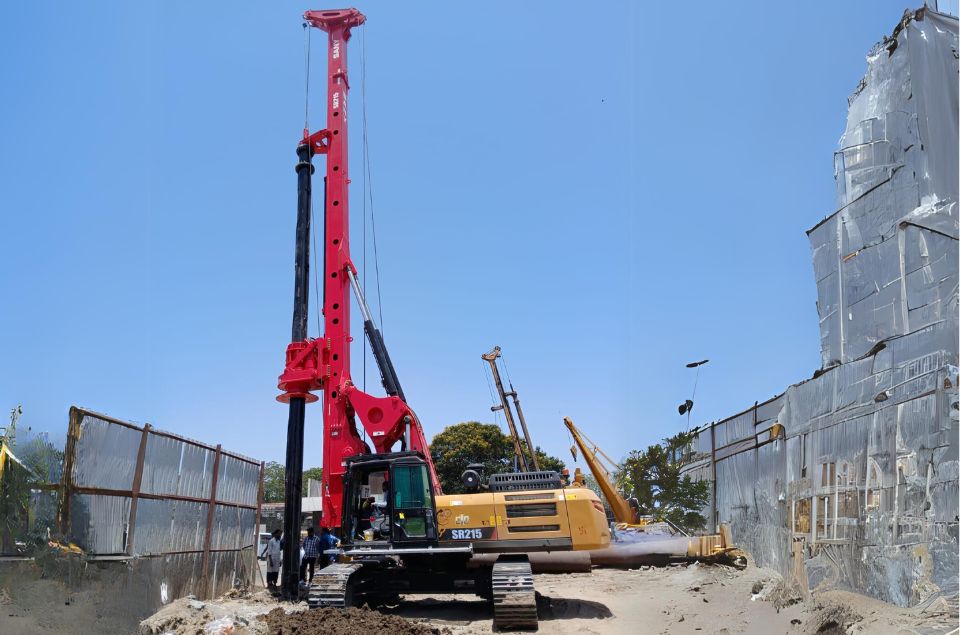
Rock Anchoring
Rock Anchoring provides passive and post-tensioned anchorage solutions for stabilizing slopes, retaining structures, bridge abutments, and deep excavations. Our team delivers end-to-end execution: investigation, drilling, installation, grouting, stressing, and proof testing—ensuring long-term performance and safety.
Where It’s Used
- Hill-slope & cut-slope stabilization
- Basement & deep excavation retention (soldier pile/diaphragm walls)
- Dam spillway/abutment anchoring and uplift control
- Rock fall protection & tunnel portals
- Tie-downs for towers, tanks, and wind foundations
Execution Steps
- Geotechnical assessment & anchor layout
- Drilling to design depth/diameter
- Installation of tendon (bar/strand) and centralizers
- Primary & secondary grouting as specified
- Stressing to design load with jack & calibrated gauge
- Proof/acceptance testing and documentation
Key Advantages
- High load capacity with controlled deformation
- Fast installation with minimal footprint in congested sites
- Durable systems with corrosion protection options
- Conforms to relevant IS/EN/ASTM testing protocols
Specification
| Anchor Type: | Threaded Bar / 7-Wire Strand (Pre/Post-Tensioned) |
| Typical Capacity: | 150 kN – 2,000 kN (project specific) |
| Drill Diameter: | 90 mm – 200 mm |
| Anchor Length: | 6 m – 30+ m (as per design) |
| Grout: | Cementitious grout (w/c as per spec), pressure grouting |
| Corrosion Protection: | Single / Double corrosion protection (SCP/DCP) |
| Equipment: | Hydraulic drilling rigs, grout pump, stressing jack |
| Testing: | Proof, Performance & Extended Creep tests |
| Documentation: | Load–extension charts, calibration, QA/QC reports |